Worried About Something? We've Covered It.
- Will I have to wait days for an appointment?
- No — we respond within 15 minutes during clinic hours, and same-day appointments are usually available.
- Is it hard to reach?
- Begumpet, Hyderabad. 2 minutes from Begumpet metro station.
- Who will treat me?
- Dr. Manisha Moorjani's team — 18+ years of experience treating knee pain.
- Is this just temporary relief?
- No. We find the root cause first, then treat that — not just the symptom in front of us.
- Will I actually recover?
- Most knee pain cases respond well to the right assessment and a structured plan. We'll give you a realistic timeline once we've assessed you.
- What will it cost?
- You'll know the exact cost after your first assessment — no surprise charges, and we explain the plan before you commit.
About Knee Pain
Knee pain shows up differently depending on who you are — a runner with pain under the kneecap, a 50-something with early arthritis, or someone a few weeks out from a sports injury. At Recure, treatment starts with working out exactly which structure is under stress — the cartilage, a ligament, the kneecap tracking, or the surrounding muscles — because a single generic "knee exercise" routine helps some of these and makes others worse.
What Causes Knee Pain?
The knee takes a different kind of strain depending on who you are and what you do — a runner's overuse pattern looks nothing like a 55-year-old's early arthritis, and a twisting sports injury is a different problem again from either. Weak quadriceps and hip muscles are a common thread across almost all of them, since they control exactly how the kneecap tracks and how much load passes through the joint itself. Your assessment focuses on isolating which structure — cartilage, ligament, kneecap tracking, or the surrounding muscles — is actually under stress, because the exercises that help one can aggravate another.
- Overuse from running, cycling, or repetitive stair climbing
- Weak quadriceps and hip muscles causing poor kneecap tracking
- Ligament injury (ACL, MCL) from a twist or sports impact
- Meniscus tear from a sudden twisting movement
- Osteoarthritis and age-related cartilage wear
- Being overweight, which increases load through the joint
Symptoms
How your knee pain behaves is often more useful diagnostically than where exactly it hurts. Pain specifically on stairs or after sitting for a while points toward the kneecap and the cartilage behind it, while swelling, locking or a clear giving-way sensation raise the possibility of a ligament or meniscus issue that needs a more careful look. We ask about all of these in detail, because the answers shape whether we start strengthening immediately or investigate further first.
- Pain around or behind the kneecap, especially on stairs
- Swelling or a feeling of warmth in the joint
- A catching, locking or giving-way sensation
- Stiffness after sitting for a while
- Reduced ability to fully bend or straighten the knee
- Clicking or grinding felt during movement
How We Treat It
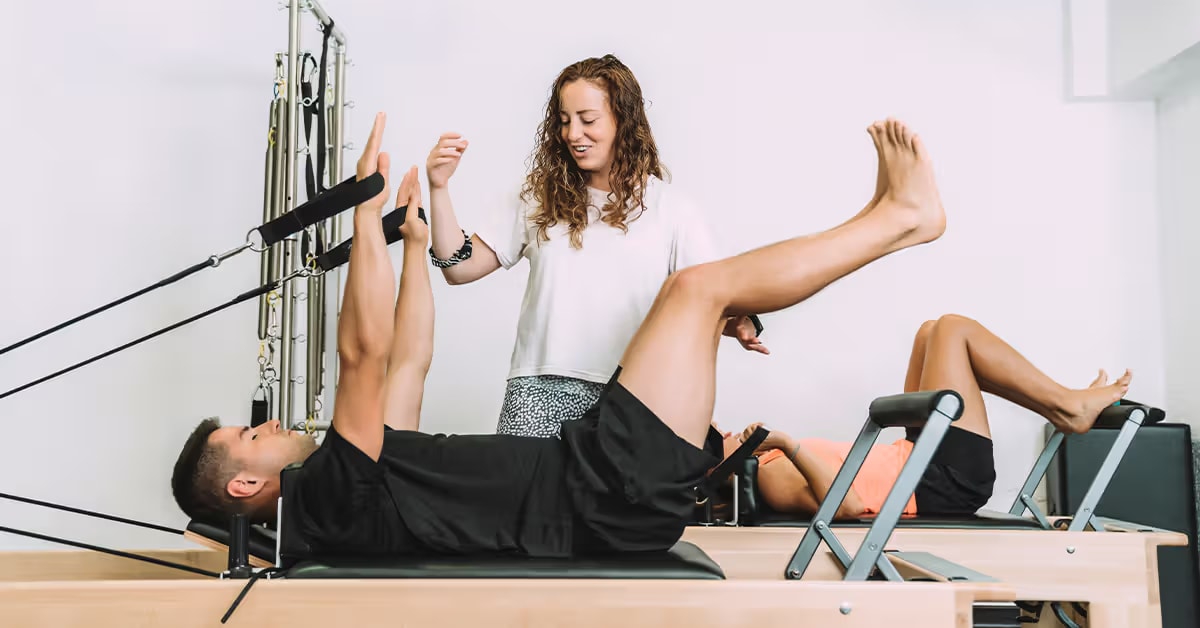
Most knee pain responds well to a structured strengthening programme — targeting the quadriceps and hip muscles that control how load passes through the joint — combined with manual therapy to settle pain and restore movement early on. Where the kneecap's tracking is the issue, taping or bracing gives it mechanical support while the surrounding muscles catch up. For anyone returning to running or sport, we use a staged programme with clear strength benchmarks at each step, rather than a fixed timeline that ignores how the knee is actually responding.
- Quadriceps and hip strengthening programme
- Manual therapy and joint mobilisation
- Taping or bracing for kneecap tracking issues
- Balance and proprioception training
- Activity modification and load management advice
- Guided return-to-sport or return-to-running programme
What Our Patients Say
4.9 average rating
Talk to Our Experts About Knee Pain
Dr Manisha Moorjani, a pioneering physiotherapist with over 18 years of expertise, has aided the recovery journeys of thousands. Born and raised in Hyderabad, she completed her Bachelor of Physiotherapy at Apollo College of Physiotherapy, Hyderabad.
Every knee pain case starts with a full assessment, not a standard protocol.
Consult Dr. Manisha